





Balázs Pósfai and the Academic Youth Award
At the award ceremony for the Hungarian Academy of Science's most prestigious research prize for researchers under the age of 35, Balázs Pósfai represented our institute among this year's winners. What does this award mean to a young person who has won practically every prize available in his age group?
It is difficult to define the age limit for youth or young adulthood with a specific number of years, however, in many cases it is necessary to set some kind of age limit. The Romans were already aware of this, as those younger than 30-35 could not run for the membership in Roman Senate, no matter how wealthy they were, and even the highest office (consul) was only attained in exceptional cases before the age of 40-45.
There is no strict age limit for today's awards either; in fact, it varies. It generally increases, although not for all awards. The age limit of 30 or 35 adopted in the early 2000s is now 40, and in certain circumstances, it can even be 45. In the case of the HSM Academic Youth Award, the age limit was raised from 30 to 35 years in 1983, and significant changes have been made since 2020. After separating it from its research network, the leadership of the Hungarian Academy of Sciences announced this award as an open competition in 2021, and not only young researchers from the former research network, but all young researchers who are members of the Hungarian Academy of Sciences could apply. The cash prize was doubled, and the number of award winners and the prestige of the award also increased.
Although this may seem like a lot about awíards and age limits, in this case it is perhaps permissible, as it helps to understand why it is such a big deal that there is hardly a year when someone from our institute is not among the winners!
Last year, we congratulated Susanne Prokop who was the 17th winner from our institute, and this year Balázs Pósfai whom I have had the pleasure of knowing since he joined our institute as a student, continues the tradition. I remember that he was still in high school and how much he enjoyed being one of the few who were able to work intensively during the summer holidays, even though no one forced them to do so.
In addition to talent, diligence, and perseverance, let's not forget the group leaders (Gábor Nyiri, Ádám Dénes) and groups, where there were people to learn from and things to learn, which brought results, expressed in awards that meant a lot to him.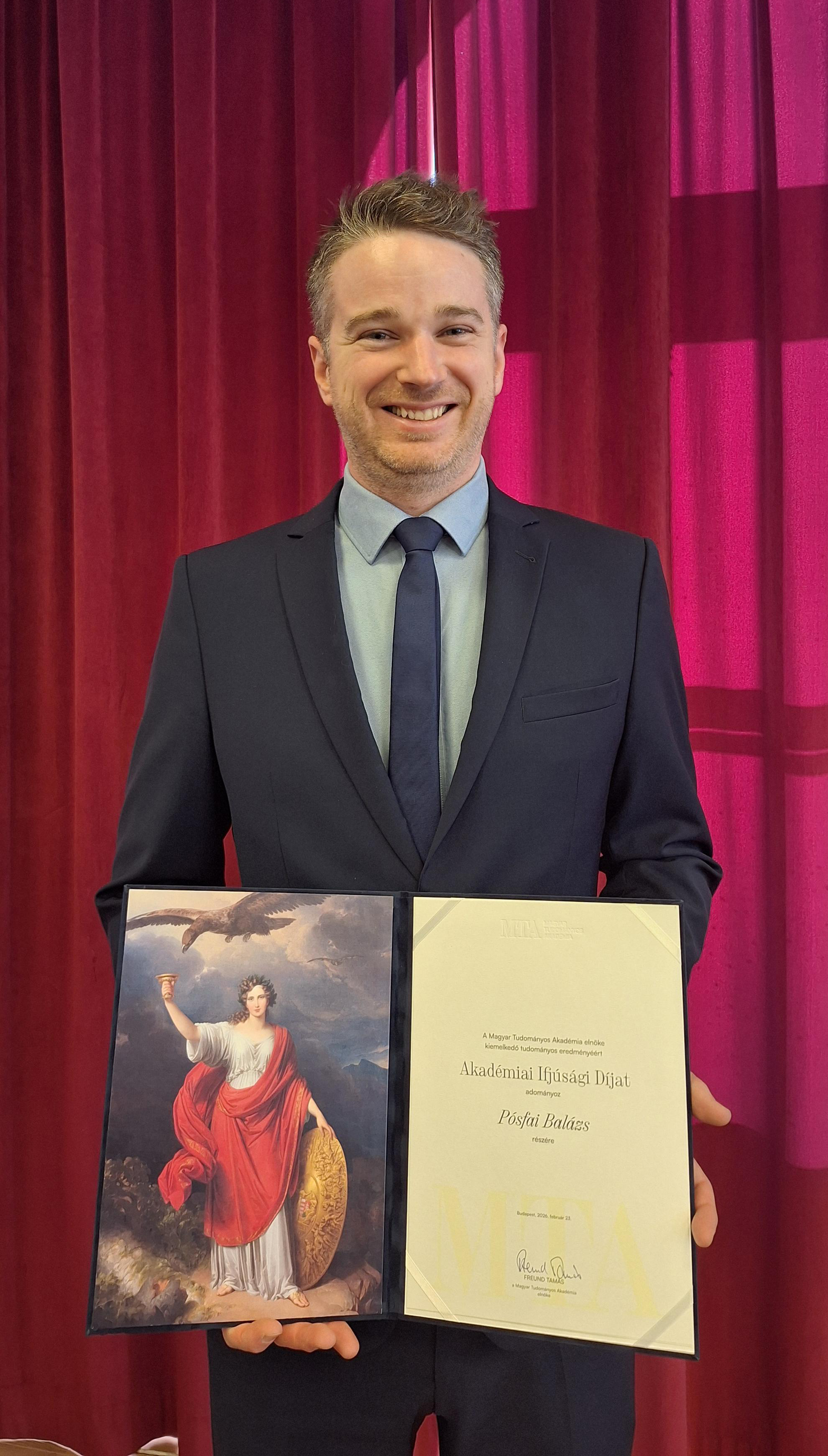
- Awards, recognition, and certificates have been very important to me since I was little; for some reason, I simply wanted them all. Still, there are awards that stand out from the rest, which you view differently when you are young. As a young researcher, these were the Bolyai János Research Scholarship and the Academic Youth Award, both awarded by the Hungarian Academy of Sciences, the highest institution of Hungarian science. And while I had already received the former, this year was my last chance for the AYA. Because no matter how much I would like to, I will no longer be eligible for the youth category of this award next year, while with the Bolyai Award, you are considered young until the age of 45!
- An award always comes at the right time—or does it?
- That's right. I believe that recognition can never come at a bad time, but this award could not have come at a better time. The past two years have been incredibly difficult in many ways. I questioned many things, including the value and quality of my research work, and my motivation, concentration, and mood were not always at their best. Hopefully, this is the confirmation I needed—because an award is always that, a kind of confirmation to the recipients that they are on the right track. It is also confirmation for those around them, as well as a good reference point and "yardstick" for those who are not involved in academic life. It is a good conclusion to the past two years and, more generally, to the first phase of my academic career.
- You said first phase. . .
- Yes. I think this award is an opportunity and a call to start a new chapter in many ways, and it is also a sign that it is time to think differently about my role in the "academic food chain." Because although it is true that I have been enthusiastically and happily supervising young people for almost a decade and have given many lectures to popularize science, I have always found it difficult to accept that I am slowly becoming a senior researcher.
- So, awards make you older, or more precisely, they make you more mature and wiser. I wish that were the case! What else would you share with those who are curious about the thoughts of a very successful young person on the subject of success?
- What definitely comes to mind is gratitude and thanks to all those who make/made these things possible. I feel that individual recognition in science is somewhat unfair, given, that nowadays, without mentors, colleagues, and teamwork, it is impossible to get anywhere in science. No one can imagine that the high school boy who sat nervously in the KOKI director's office 15 years ago, not really understanding where he was, would naturally find his way to so many awards like these. Help and support from parents, family, and teachers are essential from the very beginning. The help and guidance of mentors and more experienced senior colleagues are also essential.
And here I would like to mention three people in particular: Gábor Nyiri, in whose group I was able to take my first steps, Ádám Dénes, in whose group I was able to develop further, and Csaba Cserép, with whom I spent 14 of the 15 years in the same group. I owe all three of them a great deal. But I would not be where I am today without my many former and current colleagues and students, as they have all played an important role in my journey. From this perspective, I consider individual awards to be unfair, but all I can do in return is to strive to be a colleague and mentor who contributes to the success of others.