




Everything you want to know and see about microglia...
Although neuroimmunology was already an established branch of neuroscience research by the 1980s, its recognition was nowhere near what it is today.
Even 25 years ago, there were those who found it highly unusual that Ádám Dénes at KOKI was studying nerve cells and microglia—the brain’s resident immune cells, as anyone who has ever heard one of Ádám’s lectures might say in unison—together. Today, numerous research groups at the institute, as well as more countless than numerous foreign laboratories, collaborate with Ádám and his team. One of these is led by Miao Jing in Beijing. The results of their joint research were published in April 2026 in Neuron, one of the elite journals in neuroscience.
But let Ádám tell you about that.
“We have had a fruitful collaboration with Yulong Li and Miao Jing for several years. Our shared goal is to develop next-generation biosensors based on G-protein-coupled receptors (GPCRs) for the study of neuroimmune interactions and neurological disease processes. In the field of GPCR biosensors, Yulong Li has made a lasting contribution, as it is largely thanks to him that the in vivo monitoring of numerous neurotransmitters in the brain—from serotonin to acetylcholine—has become possible. These biosensors are also being used successfully by several research groups at KOKI.
One of Yulong’s first postdocs was Miao Jing, who now leads a successful research group at the Chinese Institute for Brain Research in Beijing.
One of our joint projects with Miao Jing was the development of brain ATP and adenosine biosensors, which allow for the detection of the release of ATP, adenosine, and other purine mediators in the brain parenchyma and the vascular environment with previously unimaginable nanomolar (10⁻⁹ M) sensitivity. In 2020, Jing Miao and I won a China-Hungary TéT grant for this topic, the main objective of which was to investigate the injury-sensing ability of microglia. To this end, several new biosensors were designed in Miao’s laboratory and optimized for real-time imaging measurements.
It has long been accepted that ATP is one of the most important injury-signaling molecules in the brain.
Our previous research has shown that, even during a brain infection, microglia identify affected neurons based on the release of local ATP. In addition, it came as a surprise to the scientific community that microglia contain nearly 50% of the brain’s adenosine, which, in addition to regulating neural network activity and complex neurophysiological processes (e.g., sleep), plays a crucial role in modulating inflammatory processes.
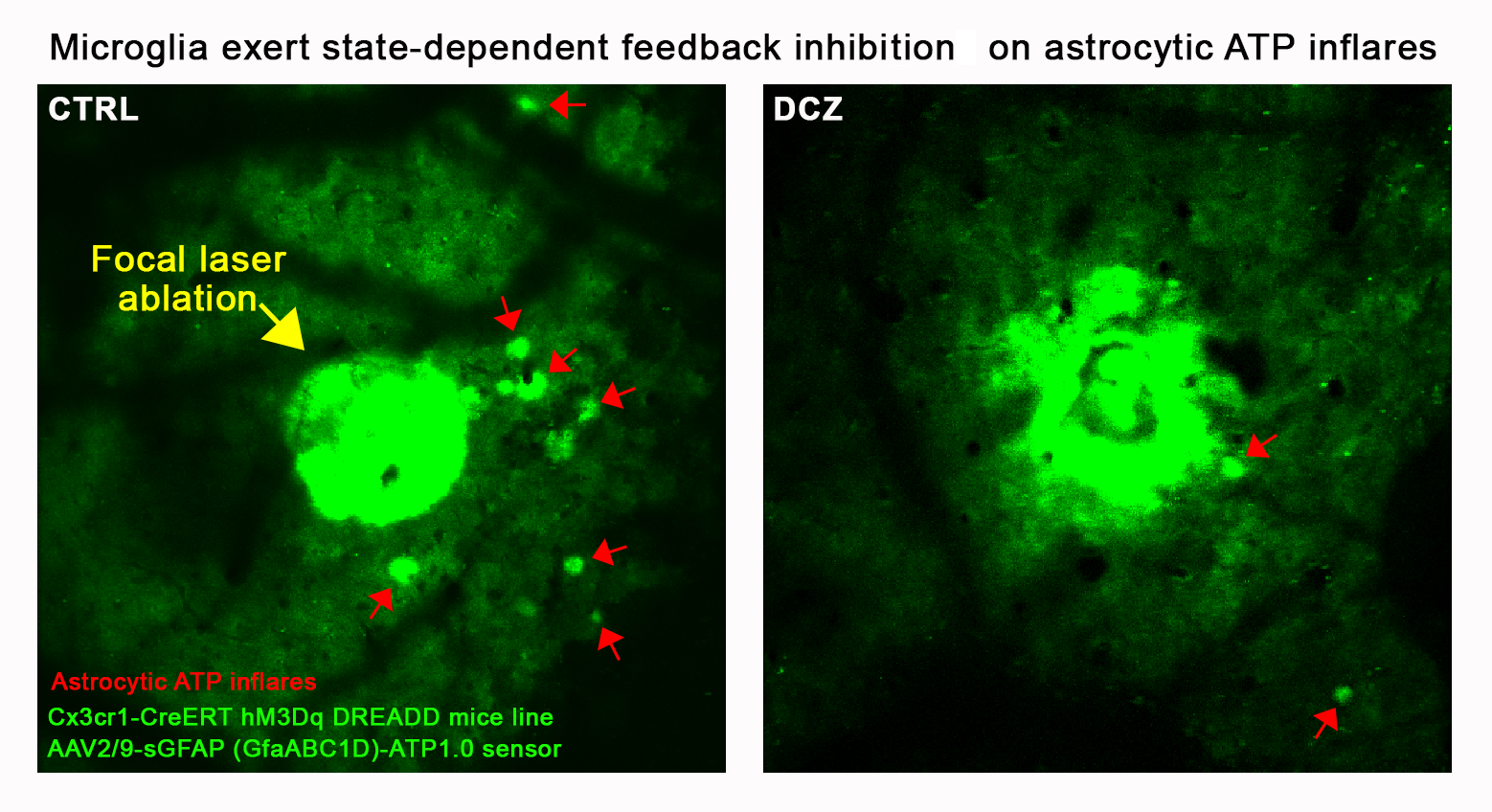
A study by Miao’s research group published in Nature Neuroscience (Chen et al. 2024 Nat Neurosci) showed that in the event of focal injury, astrocytes release rhythmic ATP bursts, which—at levels as low as a few tens of nanomoles, many orders of magnitude lower than the intracellular ATP levels of over 1 millimolar—are capable of recruiting microglial processes.
In a recently published paper (Berki et al., Nature Communications 2024), in which Miao and Yulong are co-authors, we demonstrated the crucial role that astrocyte-derived ATP plays in regulating microglia-neuron interactions. This is why, following tissue injury, microglia undergo rapid state changes while maintaining the ability to modulate complex neuronal network processes such as sharp wave ripples.
Our recently published joint article in Neuron examines how the brain controls the extent of its response to acute injuries in space and time.
It was not clear how the microglial response affects ATP production in astrocytes, nor what impact this has on the development of brain injury or neuronal network dysfunction following a stroke. We discovered that the pro-inflammatory cytokine interleukin-1 beta (IL-1β), released from microglial cells, regulates astrocyte ATP production via negative feedback, thereby limiting the spatial and temporal extent of injury in the brain.
This is particularly interesting because global inhibition of IL-1b improves outcomes in most brain injury models, such as traumatic brain injury or stroke, and clinical data support this. It has also become clear that the extent of the injury matters: presumably, in the case of brain microinjuries, microglial IL-1β production is an evolutionarily conserved, beneficial process for inhibiting the spread of injury, whereas during larger-scale brain injury or inflammation, this balance may be disrupted, inhibiting or even reversing the effectiveness of negative feedback.
The concept behind the study published in *Neuron* was developed collaboratively; the bulk of the experimental work was conducted in the Chinese laboratory, but several key experiments were performed here. Zsuzsa Környei demonstrated in multiple models that the mere presence of microglia, as well as the addition of IL-1β, limits the development of astrocyte ATP events, while Anett Schwarcz confirmed the ATP-dependent dynamics of microglia-astrocyte interactions in vivo using two-photon microscopy measurements with our MicroDREADD mouse line developed in the lab.
Overall, it can be said that various GPCR-based biosensors have already enabled numerous groundbreaking scientific discoveries, and an exciting, rapidly expanding branch of this field—the study of brain neuroimmune processes—is expected to yield many more interesting results.
Understanding the complexity of brain injury and immune processes is impossible without real-time imaging measurements, and in this regard, next-generation biosensors—particularly those using simple, rapidly metabolized molecules such as ATP—represent a major step forward.
We will continue our collaboration with Miao Jing and Yulong Li and look forward to further exciting results.