





Vaccination even during pregnancy is recommended
A new study in mice has found that COVID-19 or influenza vaccination during pregnancy does not cause the neurological changes that a real infection can trigger in the offspring. Researchers at the HUN-REN Institute of Experimental Medicine found that a treatment mimicking a viral infection produced a lasting, autism-like behavioural pattern in mouse pups, whereas the vaccines caused only mild, transient differences. The results therefore point clearly in favour of getting vaccinated.
The question is far from unfounded. It has long been known that a serious infection during pregnancy, and the maternal immune activation it sets off, can raise the risk of neurodevelopmental disorders in the child, including autism spectrum disorder. During the COVID-19 pandemic, many people began to wonder whether the vaccine itself might carry a similar risk, since it also triggers an immune response in the mother's body.
Human studies on the subject have so far failed to provide a clear, reassuring answer. On their own, however, these results cannot be used to evaluate the risks of vaccination and infection separately from the real-life decision. A pregnant woman and her doctor are not choosing between "vaccine or nothing", but between "vaccine or the risk of infection". This practical question has now been tested experimentally by the Laboratory of Molecular Pharmacology at the HUN-REN Institute of Experimental Medicine, led by Beáta Sperlágh, Member of the Hungarian Academy of Sciences.
The researchers divided pregnant mice into four groups. One group received poly(I:C), a synthetic molecule that mimics a viral infection. In the body, it triggers a strong inflammatory immune response similar to that of a real infection, and it served as the infection model. The other two groups received either a COVID-19 mRNA vaccine or the influenza vaccine Fluart, in both cases on embryonic day 12, which corresponds to the first trimester of human pregnancy. A fourth, untreated group served as the control. The team then examined the offspring's behaviour at both a juvenile (4 weeks) and an adult (8 weeks) age, measuring locomotor activity, anxiety-related behaviour, learning and memory, social behaviour and repetitive behaviour patterns. They also analysed the maternal and fetal immune responses, along with molecular markers linked to brain development.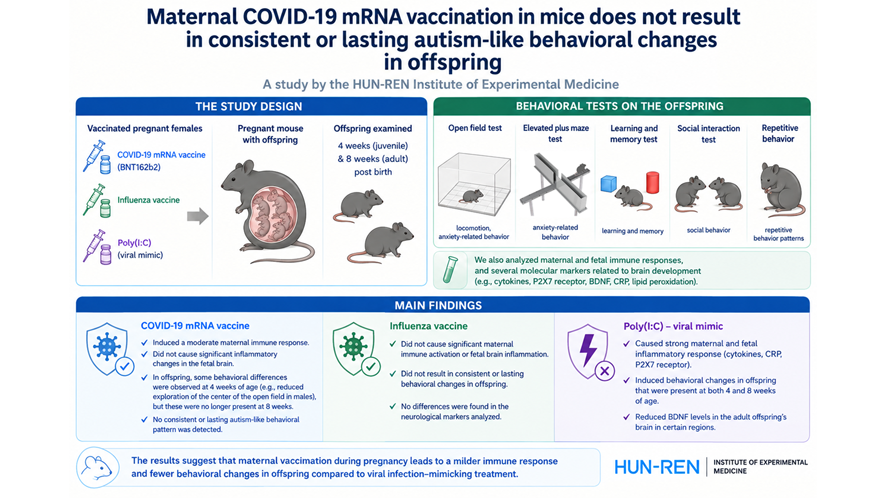
The difference between the two types of treatment was striking. The infection-mimicking treatment caused a marked inflammatory response in both the maternal circulation and the fetal brain. In the offspring, it led to behavioural changes that appeared consistently at more than one age and across several behavioural domains, such as social behaviour and repetitive behaviour patterns. By the researchers' definition, these changes were therefore classed as lasting. In certain regions of the adult animals' brains, the team also detected a lasting reduction in levels of BDNF (brain-derived neurotrophic factor), a protein that supports the survival and growth of neurons.
By contrast, the COVID-19 vaccine triggered only a moderate maternal immune response, with no pronounced inflammation in the fetal brain. At 4 weeks of age, the offspring showed a few mild, sex- and age-dependent differences. In male animals, for example, exploration of the centre of the open field decreased, which may indicate heightened anxiety. By 8 weeks, however, these differences had disappeared, and they did not add up to a coherent pattern spanning several behavioural domains that would be characteristic of autism. Analysis of the brain proteins likewise showed that, compared with infection, the vaccine's effect was considerably milder and more transient.
The researchers emphasise that the results come from an experiment in mice, so confirming the long-term effects of vaccines on neurodevelopment will require further studies in humans. Even so, the answer to the practical, everyday question – is it recommended to be vaccinated during pregnancy? – is clear. In the model studied, maternal vaccination produced a substantially weaker inflammatory response and behavioural effect than the infection-mimicking treatment. The aim, then, is not to avoid the vaccine but to prevent the infection during pregnancy, which poses the greater risk, and vaccination is the most effective way of doing so.
The findings were published in the journal Translational Psychiatry under the title "Exploring offspring behaviour after prenatal COVID-19 vaccination in mice".
This article was published on the home page of HUN-REN.